插件编写说明
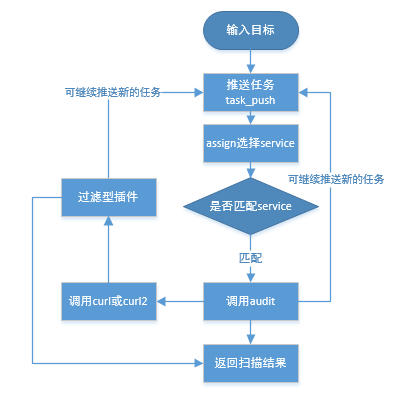
编写样例(Example)
以下是一个典型的带有详细注释的审计类型的插件,检测robots.txt的敏感信息:
#!/usr/bin/env python
# Can import any built-in Python Library
import urlparse
import re

def assign(service, arg):
    '''
    Input Parameter:
        service represents the type of the arg parameter:
            'www'       : arg is a URL such as http://www.abc.com/news.php?id=10
            'www-form'  : arg is a dict structure of a HTML form
                            {
                                'action': 'http://www.abc.com/login.asp',
                                'inputs': [
                                        {'type': u'text', 'name': u'login', 'value': 'test'},
                                        {'type': u'password', 'name': u'password', 'value': 'test'},
                                        {'type': u'radio', 'name': u'graphicOption', 'value': u'minimum'}
                                        ],
                                'ref': 'http://www.abc.com/',
                                'method': u'post'
                            }

            'ip'        : arg is a IP Address, such as 1.1.1.1
            'dns'       : arg is a Host domain, such as bbs.abc.com

            These parameters are create by the Port_and_Service_Discover built-in plugin
                service is one of 'ssh', 'ftp', 'mssql', 'mysql', 'telnet', 'vnc'
                arg is a tuple type like (ipaddr, port)

            These parameters are create by Web_Application_Recognition Plugin
                service is one of 'discuz', 'phpwind', 'wordpress', 'dedecms', 'php168', 'phpmyadmin', etc ...
                arg is a URL
    Ret Value:
        First value:
            True:  Accept the dispatch
            False: Reject the dispatch

        Second value:
            the parameter of funtion audit to be received, any type, if type is list, such as [1,2,3]
            The system automatically call function 'audit' three times, such as: audit(true, 1), audit(true, 2), audit(true, 3)

        Third Value: (optional)
            Uniquely identifies of the sub task, prevent sub task repeated
            This parameter is useful in the detection of specific vulnerabilities,
            such as you only want to audit PHP suffix URL just once, do not want all PHP files are detected, you can return like:
                return True, arg, 'php'
            'php' is the custom uuid of the sub task

    '''

    if service != "www":
        return
    arr = urlparse.urlparse(arg)
    str='%s://%s/robots.txt' % (arr.scheme, arr.netloc)
    #arg为返回的链接, pr为优先级,可以指定唯一uuid
    return True,[{'arg':str,'pr':-1,'uuid':none},]


def audit(arg):
    # arg is the second value returned by function 'assign'
    url = arg
    code, head, res, errcode, final_url = curl.curl(url)
    if code == 200:
        if re.search('Content\-Type:\s+[^\n]*text[^\n]+', head, re.M) and res.find('<') == -1:
            sensitive_info = ''
            for m in re.finditer('[^\r\n]+(admin|manage)[^\r\n]+', res, re.M | re.I):
                sensitive_info += m.group(0)
            sensitive_info = sensitive_info.strip()
            if sensitive_info:
                security_note(url + ' : ' + sensitive_info)


# Test code
if __name__ == '__main__':
    # import local simulation environment
    from dummy import *
    audit(assign('www', 'http://www.discuz.net/')[1])
另一个例子来检测discuz CMS的路径:
#!/usr/bin/env python
import re
def assign(service, arg):
    if service == "discuz":
        return True, [{'arg':arg,'pr':-1,'uuid':none},]

def audit(arg):
    code, head, res, errcode, _ = curl.curl(arg + 'uc_server/control/admin/db.php')
    if code == 200:
        m = re.search('not found in ([^<]+) on line (\d+)', res)
        if m:
            security_info(m.group(1))
以下是一个典型的过滤式插件,在HTML中寻找上传入口:
#!/usr/bin/env python
import re

'''
Only one function named 'audit', the function is automatically called during the spider crawling
    url     : the URL of current page
    head    : HTTP Response header
    body    : HTTP Body
'''
def audit(url, head, body):
    if re.search('<input[^>]+type=[\'"]*file[\'"]*', body, re.I):
        security_note(url)
以下是预加载的公共库介绍:
#!/usr/bin/env python
'''
Task scheduling:
    task_push(servie, arg, uuid=None, target=None)  Add a new sub task, such as:
        task_push('www', 'http://www.baidu.com/')
        The scheduler will transfer to all of the audit plugin
        If UUID is not specified, the system will automatically generate a UUID
        If target is specified, the new task of generating report belongs to the domain name value specified for the target

Function used to report:
    Notify      : security_note(str)
    Information : security_info(str)
    Warning     : security_warning(str)
    High        : security_hole(str)

The utility function:
    is_ipaddr(str)  check if the string is a IP address
    decode_html(head, body) Decode to utf-8 cross http response header and body
    urljoin(base, ref) such as: urljoin('http://www.baidu.com/', 'abc/../dd.html') returned 'http://www.baidu.com/dd.html'
    html2text(body, head='') HTML to Text
    get_url_host(url) get the host of url
    get_domain_root(url) Get the root domain of a URL (used built-in TLD)
    str_ration(str1, str2) return a float value represent of the similarity of two strings

curl:
    curl is a pure Python mini version of cURL, only supports the HTTP protocal
    command line format:
    [-I | -d DATA] [-A USER_AGENT] [-b COOKIE]
                    [--connect-timeout CONNECT_TIMEOUT] [-e REFERER]
                    [-H HEADER] [-i] [-m MAX_TIME]
                    [--max-filesize MAX_FILESIZE] [--mime-type MIME_TYPE]
                    [-L] [--max-redirs MAX_REDIRS] [-T] [--retry RETRY]
                    [--retry-delay RETRY_DELAY] [-u USER] [-X REQUEST]
                    <url>
    --mime-type means function will throw a exception if the Content-Type can not find the string specified by --mime-type

    return 5 parameter:
        code:       HTTP Response Code, int type
        head:       HTTP Response header
        body:       HTTP Content
        errcode:    Error code
        final_url:  Redirection of URL, no redirection if same as the visit URL

Error Code:
    CURLE_OK = 0
    CURLE_COULDNT_CONNECT = 1
    CURLE_OPERATION_TIMEDOUT = 2
    CURLE_RECV_ERROR = 3
    CURLE_SEND_ERROR = 4
    CURLE_FILESIZE_EXCEEDED = 5
    CURLE_COULDNT_RESOLVE_HOST = 6
    CURLE_UNSUPPORTED_PROTOCOL = 7

    CURLE_ARG_ERROR = 8
    CURLE_MIME_ERROR = 9

Example:
    code, head, body, ecode, redirect_url = curl.curl('-L http://www.baidu.com')
    GET:
        curl.curl('http://www.abc.com/')
    HEAD:
        curl.curl('-H http://www.abc.com/')
    POST:
        curl.curl('-d user=abc&pass=ddd http://www.abc.com/')
    PUT:
        curl.curl('T -d "Content to put" http://www.abc.com/')
    Cookie:
        curl.curl('-b user=abc&pass=ddd http://www.abc.com/')
    Referer:
        curl.curl('-e http://www.google.com/ http://www.abc.com/')
    Flow Redirect:
        curl.curl('-L http://www.abc.com/')

    cURL will automatically accept cookie in the process to obtain the Webpage, second requests will append to request header.
    If you want to empty cookies, use curl.reset()

'''

if __name__ == '__main__':
    from dummy import *
    code, head, body, error, _ = curl.curl('http://www.baidu.com/')
    if error == curl.CURLE_OK:
        print "OK"

    print util.is_ipaddr('8.8.8.8')
    print util.decode_html(head, body).decode('utf-8')
    print util.urljoin('http://www.baidu.com/', 'abc/../dd.html')
    print util.html2text(body)
    print util.get_domain_root("www.baidu.com.cn")
    print util.get_domain_root("http://bbs.sina.com.tw")
    print util.str_ratio("good", "not good")
    task_push('www', 'http://www.baidu.com/')
一些必要的解释:
- DNS Cache & TCP HOOK:
built-in DNS cache, supports multi-threading, HOOK socket levels to limit the maximum number of connections gethostbyname, gethostbyname_r The two functions have been replaced with own DNS package, Limit will cancel after call ‘reload(socket)’